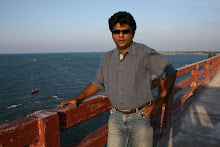
M G Devasahayam, a retired IAS officer, has written an informative article on the proposed ‘Civil Services Bill, 2009’. The article was published in The Statesman on July 7. I bump into Devasahayam occasionally when I go for my (irregular) evening walks in the beach. During our last meeting he mentioned about this article. Later, he emailed it to me. He has made the article spicy, in the style of journalists, by adding some Kerala pepper. While discussing some important features of the bill, which would impact the Indian bureaucracy, he has also highlighted the domination of Malayalee bureaucrats in Delhi. I enjoyed reading the piece. Do check it out.
PM Must Guard Against A Parochial Agenda
By MG Devasahayam
TO beat the Prime Minister’s 100-day governance agenda, the mandarins in his office are working overtime to evolve an efficient and effective public service to serve the UPA mascot ~ aam aadmi. As part of this new initiative, these reformers have placed on the fast track the enactment of a public service code that will lay down a strict performance evaluation regime for promotions and postings of senior civil servants. But even before the process has been initiated, one breed of civil servants ~ those who hail from ‘God’s Own Country’ ~ seem to be exempt from this code.
The Civil Services Bill, 2009, a draft of which is being fine-tuned, will enunciate this code. It will provide for parliamentary scrutiny on all bureaucratic appointments, transfers and postings. It is believed to be an improved version of the Public Service Bill, 2007 which did not materialise during the UPA’s previous dispensation. These provisions will first be applicable to IAS and IPS officers and may later be extended to all services that come under the all-India service category, including the Indian Forest Service.
The Bill, which incorporates various suggestions of the second Administrative Reforms Commission, envisages the setting up of a new Central Public Service Authority (CPSA). It will not only manage the civil services in a professional manner, but also serve the interests of civil servants and citizens through checks and balances. Fixed tenure
IF the Civil Services Bill becomes an Act in its present form, all bureaucrats will get a minimum fixed tenure of three years. If any bureaucrat is transferred before three years, he or she will have to be compensated for the inconvenience and harassment caused due to such a move. This is a vague provision. What sort of ‘inconvenience and harassment’ can an official claim if he is transferred ten times in three years within the same building and retains the same residence?
As regards the top-level appointments in states, the Chief Secretary and Director-General of Police will be selected out of a panel of suitable candidates by a committee comprising the Chief Minister, the leader of the Opposition and the home minister. Currently, the Chief Minister alone decides on such appointments.
Similarly, the leader of the Opposition will also have a say in the appointment of the Cabinet Secretary who will be selected from a panel by a committee comprising the Prime Minister, the leader of the Opposition and the home minister. If the government deviates from these norms while appointing bureaucrats, it will have to inform Parliament about the reasons for doing so.
The new Bill will put in place a different kind of performance evaluation system. Unlike the current practice of Annual Confidential Reports which take a panoramic and often prejudiced view of a civil servant’s work, the new performance management system will evaluate officials on their job-specific achievements and the number of tasks that they perform as a team leader in a particular department.
The system will be managed by the CPSA which will work under a chairman whose rank will be equivalent to that of the Chief Election Commissioner. The CPSA, comprising three to five members, will have the power to recommend action against the public servants who do not adhere to the codes and values of public service. The Authority will assist and advise the Centre in all matters concerning the organisation, control, operation and management of public services and public servants.
The CPSA will also be the custodian of the public service code for civil servants. It will be framed to facilitate civil servants ‘in discharging official duties with competence and accountability; care and diligence; responsibility, honesty, objectivity and impartiality; without discrimination and in accordance with the law’.
The incubating Public Service Bill, 2007 contained certain Values of Public Services: (a) patriotism and upholding national pride; (b) allegiance to the Constitution and the law of the nation; (c) objectivity, impartiality, honesty, diligence, courtesy and transparency; (d) absolute integrity. It is a travesty that after six decades, a law has to be enacted to inculcate values in our elite civil servants, indeed values that are expected of any ordinary citizen.
The reforms to develop the public services as ‘a professional, neutral, merit based and accountable instrument for promoting good governance and better delivery of services to the citizens’ is a bold and assertive step by the Prime Minister and his team and, therefore, deserves to be welcomed.
Quite the contrary
BUT what is actually happening, presumably with the knowledge of the Prime Minister, is quite the contrary. Of late, a mini-replica of ‘God’s Own Country’ has been created in New Delhi’s corridors of power, originating from the Prime Minister’s Office itself. Almost every conceivable top civil service post has been captured either by those who belong to ‘God’s Own Country’ or speak the language of that ‘land of lagoons’.
The list looks endless and impressive ~ National Security Advisor; Secretary to the President of India; Principal Secretary to the Prime Minister; Cabinet Secretary; Home Secretary; Foreign Secretary and the Secretaries to the Government of India in the Ministries of Civil Aviation, Coal, Mines, Labour and Employment, Legal Affairs, Overseas Indian Affairs, Urban Development, Space, Textiles, Heavy and Information & Broadcasting! Till recently Finance and Commerce Secretaries also belonged to this ilk.
It looks as if those who were involved in this process of selection and placement ran out of candidates. Otherwise, the list would have been much longer. These ‘selectors’ are forever alert. In anticipation of the retirement of the incumbent Foreign Secretary at the end of July they have already announced his replacement ~ another lady from ‘God’s Own Country’! Even the next Police Commissioner of Delhi would be from this clan. The list seem to be endless.
No public service code or reform initiative will have any meaning or credibility if this debilitating parochial inbreeding doesn’t stop. The least that the Prime Minister can do is to submit this ‘parochial’ agenda to parliamentary scrutiny as envisaged in the proposed Civil Services Bill. The question is: will he or can he?
Thursday, July 16, 2009


Thursday, July 9, 2009
Tamil refugee camps of Sri Lanka
Much has been written about the abysmal conditions of the Tamil refugee camps in Sri Lanka. Reports say people there are suffering due to shortage of water, and lack of proper sanitary facilities. Media has also reported outbreak of chickenpox and hepatitis in the military run camps, where an estimated 3 lakh Tamils are housed in overcrowded tents. Several international agencies have voiced their concern for the suffering masses, but no relief appears to be in sight.
Their appalling condition moved even Sri Lanka’s Chief Justice Sarath N Silva, who made the following comments after visiting one of the camps. (That the honourable judge is a Sinhalese adds more credibility to his remarks.) Here goes his assessment of the camps:
“I visited 'relief villages' where Vanni IDP families are sheltered. I cannot explain their suffering and grief in words. It is an utter lie if we continue to say that there is only one race and no majority or minority in the country. I visited Cheddiku'lam camps where IDP families live. I cannot explain the pathetic situation they undergo. I was unable to console them. They survive amid immense suffering and distress.
We construct massive building on our side. But these IDPs live in tent-shelters. Ten IDPs live in one tent-shelter. They could stand straight only in the centre of the tent shelter. Their neck will break down if they move to aside of the tent-shelter.
IDPs are seen waiting in queues, extending from 50 to 100 yards to take their turn to answer a call of nature. This is the life of Vanni IDPs in Cheddiku'lam camp.
I attempted to smile at these IDPs. But it was without success. I failed to express my feeling towards them. I was unable to tell them that we also were crying with them for their suffering. I was unable to tell them that I would supply new clothes to them.
They should be provided with enough relief. We would be blamed if we fail to supply them with enough relief.They cannot expect justice from the law of the country. Their plight and suffering are not brought to the court of law in our country. I openly say this. I will be penalized for telling this.”
Now, contrast these remarks with Sri Lankan President Mahinda Rajapaksa’s rating of his army run camps in an interview with senior Indian journalist and the Editor of leading Indian English daily, The Hindu. To a question from Ram on whether he was satisfied with conditions in the Vavuniya IDP camps, Rajapaksa said (I am quoting in part)…
“I would say the condition in our camps is the best any country has. We supply water. There is a problem with lavatories. That is not because of our fault. The money that comes from the EU and others, it goes to the NGOs and the U.N. They are very slow; disbursing money is very slow. We supply the water tanks; we have spent over [Sri Lankan] Rs. 2 billion. Giving electricity, giving water, now we are giving televisions to them. They have telephone facilities. Schools have been established. Some of the leaders are using mobile phones.
I had a special meeting on the disposal of waste. I sent a special team of specialists to see how mosquitoes can be eradicated.
We know there are shortcomings. Slowly, we have to overcome them. In some camps there are no problems. What these people I sent told me: they are satisfied with the housing, the shelter. They have undergone much worse conditions earlier [when they were under the LTTE’s control].”
Rajapaksa also revealed during the course of the interview a very powerful theory that he has formulated and which he is propagating among his countrymen.
He said answering a question:
“I have warned my party people, all party people, whether Sinhala, Tamil or Muslim, that “I don’t want any statement, anything that creates a disturbance among our three communities.” Now my theory is: there are no minorities in Sri Lanka, there are only those who love the country and those who don’t. They tried to twist that but I still maintain that position.”
Now you go paraphrase what the President means when he says there are no minorities in Sri Lanka. Good luck to the Tamils!
Tuesday, June 30, 2009
Inspiring Fathers - Nehru and Lincoln
I am reading Jawaharlal Nehru’s Glimpses of World History. Truly, leaders such as him, are scarce to find in the present world. I found Nehru’s keenness to pass on his own values to his daughter, Indira, most touching. Through the letters he wrote to her from the prison, he attempted to impart knowledge to her, while at the same time, sneaking in capsules of character building verses. Narrating historical events from around the world, he tries to mould her character, subtly infusing into her the qualities of legendary heroes who had lived in the past.
At times, he is quite blunt in telling her how she should live her life. I liked this passage, early in the book:
“Often we may be in doubt as to what to do. It is no easy matter to decide what is right and what is not. One little test I shall ask you to apply whenever you are in doubt. It may help you. Never do anything in secret or anything that you would wish to hide. For the desire to hide anything means that you are afraid, and fear is a bad thing and unworthy of you. Be brave, and all the rest follows. If you are brave, you will not fear and will not do anything of which you are ashamed.”
This passage is part of Nehru’s letter to Indira on her thirteenth birthday. No wonder, Indira grew up into a daredevil politician and was once hailed as “the only man in her cabinet.”
No less inspiring is former American President Abraham Lincoln’s letter to his son’s teacher…
“He will have to learn, I know, that all men are not just, all men are not true. But teach him also that for every scoundrel there is a hero: that far every selfish politician, there is a dedicated leader…
Teach him that for every enemy there is a friend. It will take time, I know a long time, but teach, if you can, that a dollar earned is of more value then five of found.
Teach him, to learn to lose…And also to enjoy winning. Steer him away from envy, if you can, teach in the secret of quiet laughter.
Teach him, if you can the wonder of books…But also given quiet time wonder the eternal mystery of birds in the sky, bees in the sun, and flowers on the green hillside.
In a school teach him, it is far more honorable to fail than to cheat…
Teach him to have faith in his own idea, even if anyone else tell him they are wrong…
Teach him to be gentle with gentle people and tough with tough.
Teach him to listen to all men…But teach him also to filter all he hears on a screen of truth, and take only the good one that comes through.
Teach him, if you can, how to laugh when he is sad. Teach him there is no shame in tear.
Teach them to sell his brawn and brain to the highest bidder but never to put a prize tag on his heart and soul.
Teach him gently, but do not cuddle him, because only the test of fire makes the fine steel.
Teach him always to have sublime faith in himself because then he will always have some sublime faith in mankind.
This is a big order, but see what can you do… He is such a fine little fellow, my son! Dad”
Subscribe to:
Posts (Atom)